Princeton University Press · 2024
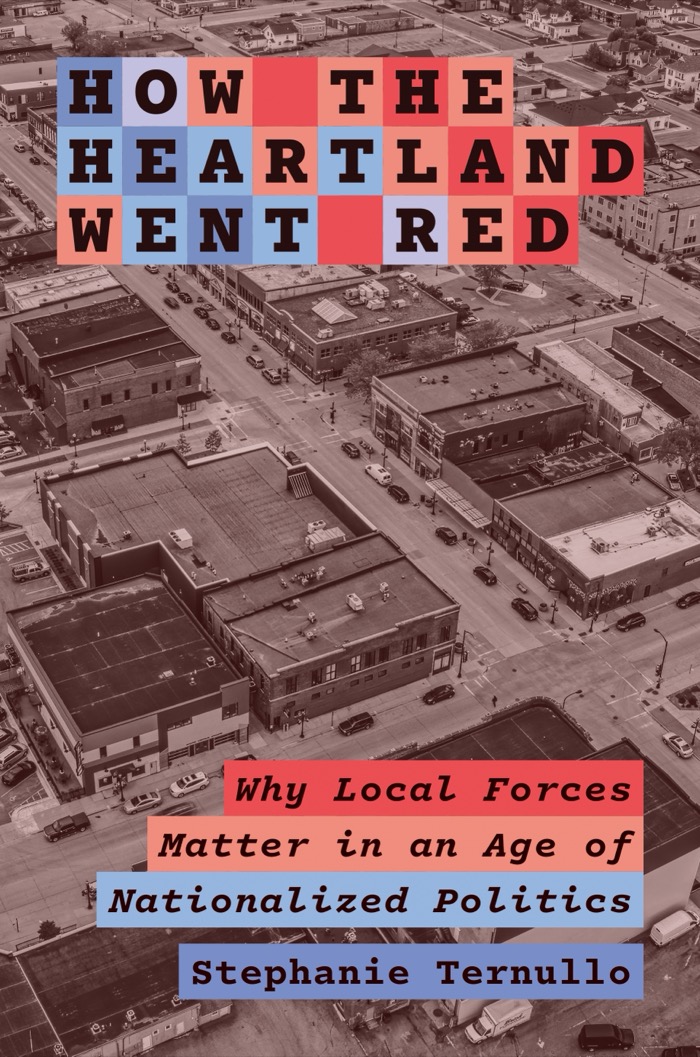
How the Heartland Went Red
Why Local Forces Matter in an Age of Nationalized Politics
Why did some white, working-class communities swing hard to the Republican Party while others, much like them, did not? This book argues that the answer lies in local context—the institutions, organizations, and narratives through which residents make sense of national politics.
About the book
Overview
Over the past several decades, predominantly White, postindustrial cities in America’s agriculture and manufacturing center have flipped from blue to red. Cities that were once part of the traditional Democratic New Deal coalition began to vote Republican, providing crucial support for the electoral victories of Republican presidents from Reagan to Trump. In How the Heartland Went Red, Stephanie Ternullo argues for the importance of place in understanding this rightward shift, showing how voters in these small Midwestern cities view national politics—whether Republican appeals to racial and religious identities or Democrat’s appeals to class—through the lens of local conditions.
Offering a comparative study of three White blue-collar Midwestern cities in the run-up to the 2020 election, Ternullo shows the ways that local contexts have sped up or slowed down White voters’ shift to the right. One of these cities has voted overwhelmingly Republican for decades; one swung to the right in 2016 but remains closely divided between Republicans and Democrats; and one, defying current trends, remains reliably Democratic. Through extensive interviews, Ternullo traces the structural and organizational dimensions of place that frame residents’ perceptions of political and economic developments. These place-based conditions—including the ways that local leaders define their cities’ challenges—help prioritize residents’ social identities, connecting them to one party over another. Despite elite polarization, fragmented media, and the nationalization of American politics, Ternullo argues, the importance of place persists—as one of many factors informing partisanship, but as a particularly important one among cross-pressured voters whose loyalties are contested.
By moving between the individual and the community, the book illuminates the meso-level mechanisms that connect personal attitudes to broad political change—the civic organizations, local leaders, and shared narratives through which residents make sense of a changing country. The result is a portrait of American political life that takes place seriously, and a rejoinder to accounts that treat the “heartland” as a single, undifferentiated bloc.
- ★ Winner — Distinguished Contribution to Scholarship Book Award
- ★ Winner — Outstanding Book Award
- ★ Honorable Mention — Dennis Judd Best Book Award
“A powerful argument that economic, cultural, and political developments at the local level still matter a great deal.”
“Intensive fieldwork and careful theorizing… illuminating how structure and culture shape communities.”
-
City JournalReviewRead →George Hawley on local forces and the rightward shift
-
Oxford Political ReviewReviewRead →On what the book adds to the politics of place
-
New Books NetworkPodcastListen →Author interview about the book
-
C-SPAN, Washington JournalInterviewWatch →Stephanie Ternullo on How the Heartland Went Red
Also reviewed in Perspectives on Politics, the American Journal of Sociology, Political Science Quarterly, International Social Science Review, the Revue Française de Science Politique, and Choice.
Get the book